
When investing in a commercial or industrial floor scrubber, choosing the right battery setup is just as critical as selecting the machine itself. The battery package you choose directly dictates your daily runtime, maintenance labor, and long-term operating costs.
At Robey’s PowerKleen, our family has spent over four decades in the commercial floor machine industry. We believe your team should spend their time cleaning floors—not managing battery chemistry.
If you are deciding between traditional Lead-Acid and advanced Lithium, or wondering whether a 100Ah or 200Ah package fits your facility, here is everything you need to know.
| Spec / Feature | Standard Lead-Acid Setup | 100Ah / 200Ah Lithium Battery |
| Nominal Voltage | 24V (4x 6V or 2x 12V cells) | 25.6V (Stable High-Output Voltage) |
| Total Energy | ~2.4 kWh to 3.8 kWh | 5,120 Wh (5.12 kWh) |
| Charging | 12 Hour Full Cycle | 6 – 8 Hours or less Full Cycle (usually half of lead-acid charging time) |
| Maintenance | Weekly Water Topping Required | Zero Maintenance (Sealed LiFePO4 System) |
| Interbattery Wiring | 3–5 Failure-Prone Jumper Cables | Single Pack Unit (No Corroding Jumpers) |
| Board / Harness Protection | High Risk of Acid Oxidation | 100% Acid-Free (Protects $3,500+ in Electronics) |
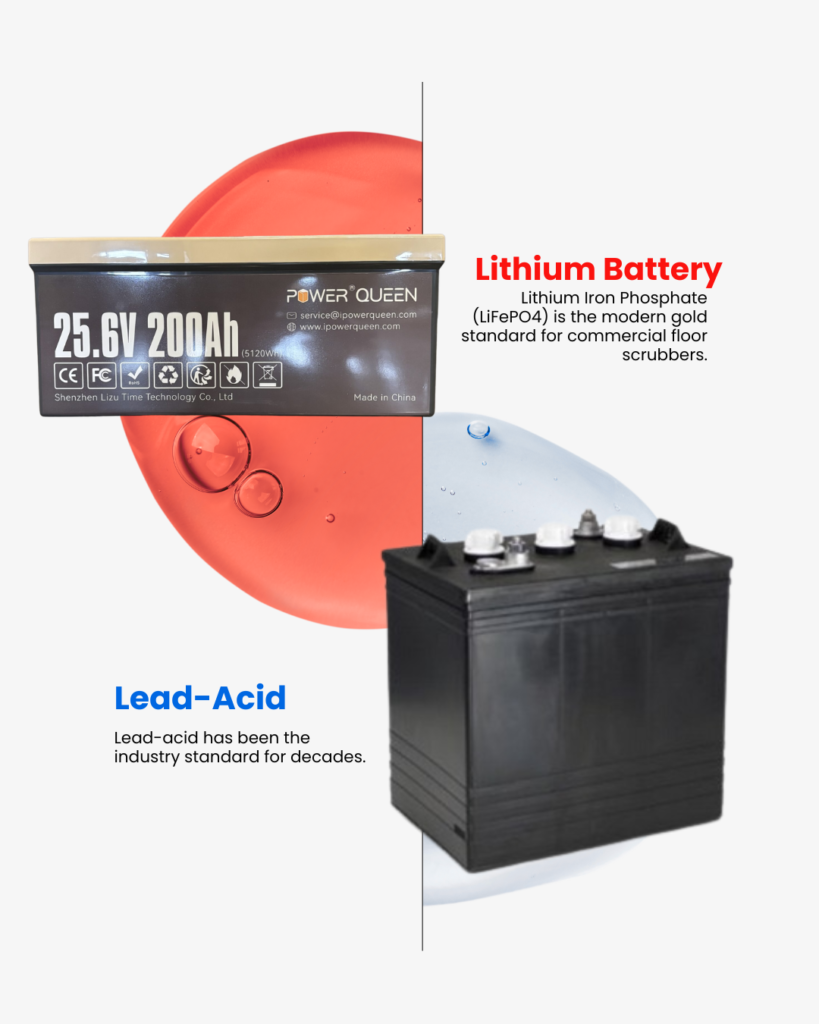
Lead-acid has been the standard option for decades, offering a lower initial purchase price. However, lead-acid chemistries are highly sensitive to user error and environmental conditions.
Lithium Iron Phosphate (LiFePO4) is modern technology built for rugged commercial environments. While the upfront cost can be slightly higher, lithium provides the lowest Total Cost of Ownership (TCO) over the lifespan of your machine.
Think of Amp-Hours (Ah) as the size of your scrubber’s fuel tank—higher Ah capacity means more continuous cleaning time per charge:
| Package Option | Estimated Runtime | Ideal Facility / Application |
| 100Ah Package | ~2 – 3.5 Hours per charge | Small-to-medium floors, single-shift daily spot cleaning, retail aisles, and standard maintenance routines. |
| 200Ah Package | ~3.5 to 5+ Hours per charge | Large warehouses, heavy industrial deep-scrubbing, and high-traffic multi-shift facilities requiring extended runtimes. |
Runtime numbers vary based on machine size and floor environment:
If your team struggles to keep up with routine battery watering—or if your facility runs multiple cleaning shifts—Lithium pays for itself quickly by eliminating replacement cell costs, preventing acid damage to internal electronics, and keeping your equipment ready to work.
However, if you have a lower upfront budget and only scrub for an hour or two a day, a traditional Lead-Acid package remains a dependable entry-level choice.
Not sure which battery size or chemistry fits your floor plan? Contact us today or stop by our shop to test out a machine in person!
Give us your name and number and our team will contact you as soon as possible.
Enter your email below to instantly unlock a $1,000 discount code toward your next equipment purchase.
🔒 We respect your privacy. No spam, ever.