

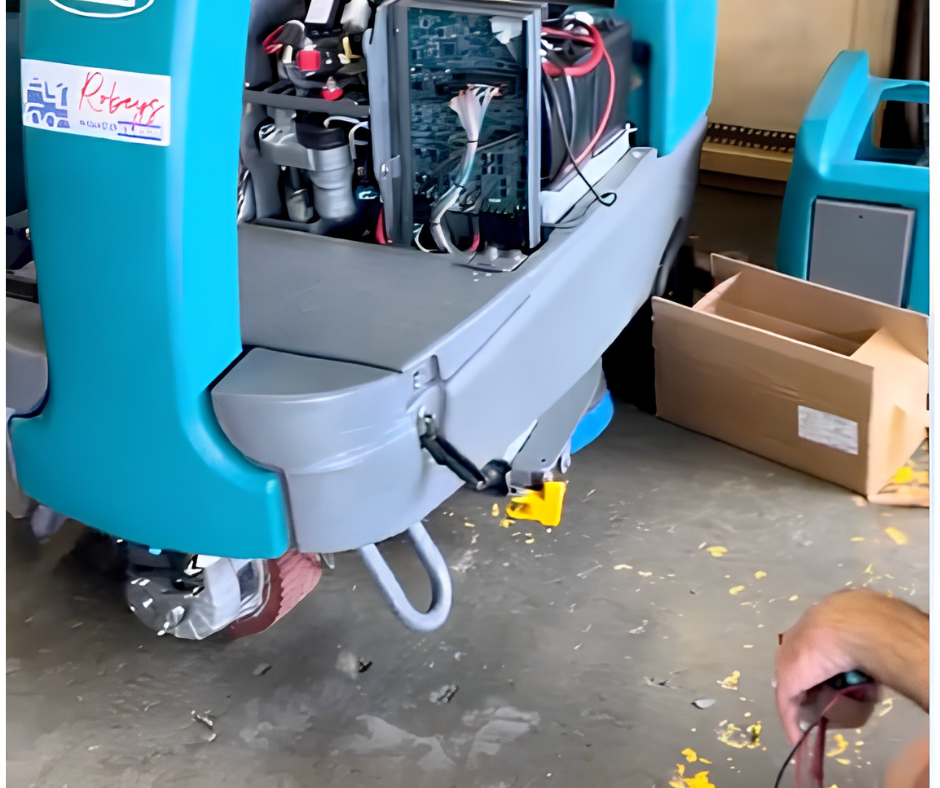
It’s the start of a busy shift: you sit down on your Tennant T7 (or Nobles SS Rider), turn the key switch, press the propel pedal—and nothing. The machine won’t move. Instead, it sits there emitting a frustrating, repetitive 7-beep error code sequence.
When a commercial floor scrubber suddenly refuses to drive, it can bring your facility’s cleaning operations to a grinding halt.
At Robey’s PowerKleen, we specialize in refurbishing, servicing, and repairing top-tier floor scrubbers. In this guide, we break down what that 7-beep error code means, how to troubleshoot it step-by-step, and how to get your Tennant T7 moving again without calling an expensive service technician.
On the Tennant T7 and Nobles SS Rider platforms, beep codes are the machine’s internal diagnostic system.
When you experience a 7-beep code accompanied by a “No Drive” condition, the machine is signaling a propel circuit or throttle fault. Essentially, the main control board is not receiving a valid electrical signal from the foot pedal potentiometer, or it detects an engaged safety interlock that disables the drive motor circuit entirely.
Before ordering expensive replacement control boards or drive motors, follow our diagnostic checklist to isolate the problem:
The Tennant T7 features a pressure sensor under the operator’s seat. If the control system doesn’t detect an operator in the seat, it cuts power to the drive motor to prevent a runaway machine.
Because the 7-beep code directly points to a propel signal fault, the foot pedal assembly is the most common culprit. The potentiometer inside the pedal converts foot movement into speed signals for the motor.
If the manual brake release lever on the front drive wheel hub is disengaged (often done to push a dead machine manually), the electrical system will prevent motor operation for safety.
(Watch our lead technician demonstrate how to test the seat switch, throttle pedal, and brake lever using a multimeter in under 2 minutes)
If the seat switch, pedal connector, and brake lever check out fine, test the main wiring harness for continuity or inspect the main controller board for corrosion or blown fuses.
No! Throttle switches and potentiometers are simple, cost-effective replacement parts that can be swapped out quickly in your maintenance shop.
If your old equipment is constantly throwing error codes and costing you money in operational downtime, it might be time for an upgrade.
At Robey’s PowerKleen, we offer premium factory-refurbished floor scrubbers that deliver like-new performance at a fraction of the cost of new equipment. Every unit undergoes a rigorous multi-point rebuild by our certified-service technicians.
Get back to clean floors today:
Visit Our Showroom & Service Center: 695 N Main St., Winchester, KY 40391
Give us your name and number and our team will contact you as soon as possible.
Enter your email below to instantly unlock a $1,000 discount code toward your next equipment purchase.
🔒 We respect your privacy. No spam, ever.