

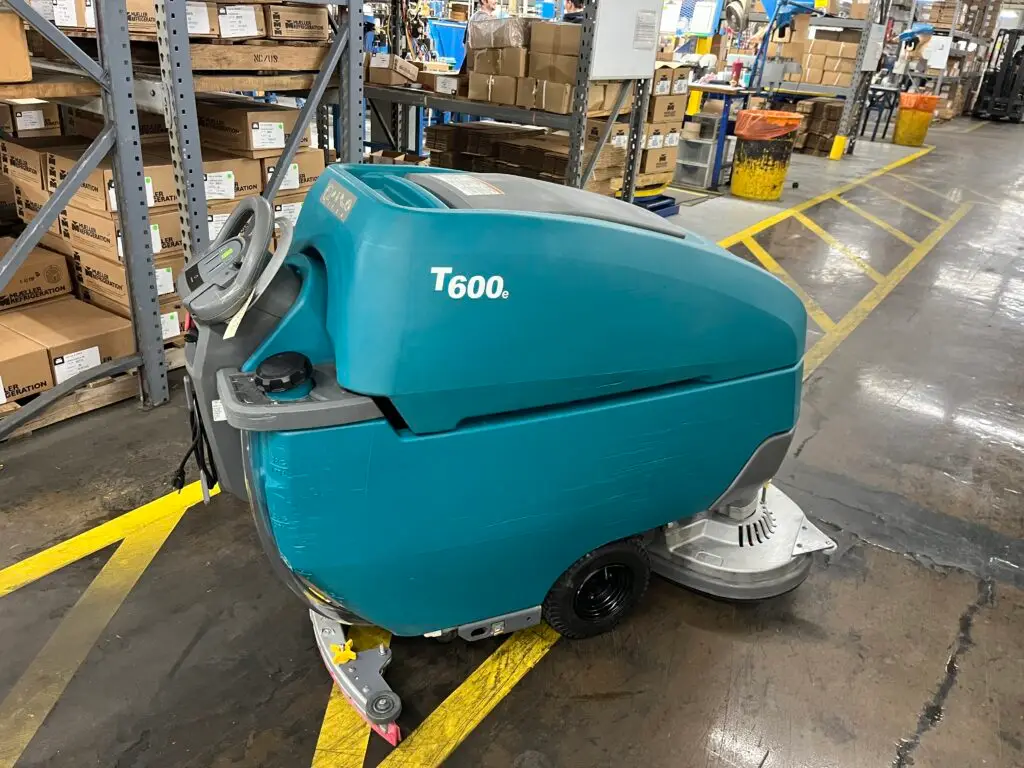
The vac motor is humming and the brushes are scrubbing. But when you look back, there are puddles at the ends of the squeegee, streaks down the aisle, or a film of dirty water drying where it shouldn’t be.
When a Tennant T600 walk-behind loses suction, the motor is rarely the problem. Usually air is getting into the system somewhere, or something is blocking the path between the squeegee and the recovery tank. Most of the fixes are free, and most take a few minutes with no tools.
In the video below, our technician walks around a T600 and shows you every spot to check, from the tank lid down to the squeegee. Follow along at the machine.
The T600 picks up water through one sealed loop:
The whole system depends on an airtight seal. If air sneaks in anywhere, through a lid that won’t seal, a loose drain cap, or a squeegee riding off the floor, suction drops everywhere. That’s why the checks below follow the air path from the top of the machine down to the floor.
Open the recovery tank lid and prop it up. Most suction problems on a T600 show up right here.
The yellow debris tray catches trash as dirty water pours into the tank. When it’s packed full, water and debris back up near the inlet. Empty and rinse it after every shift.
Under the lid, a cylindrical screen filter sits over the vac motor inlet. It keeps debris and foam out of the motor.
Pull it off and look closely:
With the filter back on and the vacuum running, put your hand over the vac hose opening on the tank. You should feel a strong, steady pull.
The rubber gasket around the recovery tank lid is what makes the tank airtight. If it’s torn, peeling, flattened, or caked with dirt, air leaks straight in and the vac motor can’t pull water up the hose.
Run your finger around the whole gasket. Wipe it clean, press loose sections back into place, and replace it if it’s cracked or torn. Then close the lid and make sure it sits flat all the way around.
The recovery tank drain hose hangs at the back of the machine. If its cap is loose, cracked, or missing, the tank pulls air through it instead of through the squeegee. Screw it on snug every time you drain the tank.
Squeegee hose. Pull the vacuum hose off the squeegee and feel for suction at the open end. It should feel about as strong as it did at the tank.
Squeegee blades. Loosen the yellow knobs and take the squeegee off to check the rubber.
Lower the squeegee and watch the rear blade as you push the machine forward. You want a slight, even bend along the whole blade. If it stands straight up, skips, or barely touches the floor, air gets in under it and water gets left behind.
Print it and keep it near the charger.
Most of these fixes cost little or nothing. The real cost of weak suction is the re-cleaning, the slip hazards, and the labor hours you don’t get back.
If you’ve worked through the list and your T600 still won’t pick up, PowerKleen can get you the right parts or send a tech.
Rather talk it through? Give us a call. We’re happy to help you figure out what’s going on.
Give us your name and number and our team will contact you as soon as possible.
Enter your email below to instantly unlock a $1,000 discount code toward your next equipment purchase.
🔒 We respect your privacy. No spam, ever.